
Iconography of the Monastic Midlands
Contributor Alicia King contemplates the profound beauty of symbols employed in Medieval Ireland as a reflection of her experience during the Irish Heritage School’s (IHS) Monastic Midlands Field Anthropology Summer Program.
When you think of Ireland, I am guessing a few things that come to mind: Guinness, four-leaf clovers, Spice Bags, Normal People by Sally Rooney (and by association, Paul Mescal). I would bet that the small, unassuming town of Birr is not on that list. However, I had the privilege of attending the Irish Heritage School’s (IHS) Monastic Midlands Field Anthropology Summer Program, which brought me to this country town, and I can tell you it is anything but unassuming. Birr is a place of rich history, vibrant culture and a beautiful close-knit community. The program focused on the analysis and survey of medieval sites, which naturally came with an abundance of iconography and symbols, each with its own story. I’d like to share a few that I found particularly compelling, which led me to some unexpected reflections on the nature of symbols as a whole.
Rosettes

On the first day of the program, we were taken on a tour of Birr, which included the ruins and graveyard of St Brendan’s Church, a site where we would later be conducting survey work. We were given time to explore the grounds and were tasked with noting anything that we thought might be significant. I immediately noticed a recurring floral motif across various graves, which I later learned is called a Rosette (also known as a hexfoil, hexafoil, or daisy wheel), typically a six-pointed, geometric flower.
Although I encountered it primarily in a medieval burial context, the Rosette has pagan origins and was used as a symbol of protection. A recent research project by Robyn Lacy suggested that the symbol may have served a similarly protective function on graves, however, there is no firm evidence that this was intentional, as the motif became something of a trend and spread into post-medieval everyday contexts, appearing on furniture and architecture alike. The adoption of pagan or religious iconography into wider decorative use was itself a recurring pattern throughout the program, one that often causes the original meaning and significance to be lost over time. Lacy traced the rosette back to its pagan roots, but we still don't fully understand why it was chosen as a symbol of protection, precisely because of how broadly and casually it was later used. This consequence applies to the other symbols we came across as well.
Rag trees

I came across several ‘Rag trees’ throughout the program, which I found to be an unexpectedly moving experience. The belief is that if you tie a rag, piece of cloth or ribbon to one of these trees, the illness of the person to whom it belonged would disappear as the fabric degrades. There are many of these trees surrounding Birr, and it remains a living practice observed by Christians, Pagan practitioners and members of the Traveller community.
Each Rag tree is a living symbol of hope and belief. Around them, you could also find personal belongings and photographs, telling deeper stories of hardship. They are powerful reminders of the importance of community, and each one tells a different story. This moved me far more than I anticipated, and I was privileged to take part in the practice by adding my own rag to one of the trees.
IHS

The IHS symbol (not, I should clarify, an abbreviation for the Irish Heritage School) was probably the most frequently occurring icon on the gravestones we encountered. Several of us inquired about its meaning, but unfortunately, it is another symbol that has become a ‘trend’ with such intense use that the original meaning is virtually impossible to discern. It is most likely an abbreviation or reference to Jesus Christ, making it a symbol of Christian use. Some suggest that IHS represents the first three letters of Jesus in the ancient Greek alphabet (personally, I find that hard to believe, I mean, why only the first three letters?). As Latin became more prevalent, it was interpreted as standing for Iesus Hominum Salvator (‘Jesus, Saviour of Mankind’). It has also been referred to as an acronym for ‘I Have Suffered’ or ‘In His Service.’ Regardless of the ‘official’ wording, the meaning has remained more consistent as an obvious appeal to God at one's death.
These are just some examples of a larger thought that I could not shake throughout the program: How can we possibly know exactly what all these symbols are intended for? It is not even evident if they all had a deep meaning; for all we know, they could simply be decorative. When we are the ones whose symbols are being excavated by archaeologists of the distant future, how co

uld they possibly know what we intended through our use of symbols? I have decided that…It doesn’t matter. For something to appear on a grave, it must have been important to some degree, even if that importance was simply that the person being honoured had a decorative grave. We do not need to understand or know what they meant or felt about these icons. Instead, we can appreciate that they were important to these people and even form our own connection to and meaning for them. At the end of the program, I had a Rosette tattooed on my arm with one of the many friends I made throughout the experience. This symbol has taken on a new meaning for me, as a reminder of this beautiful history I had the privilege of learning about with amazing people I learned it with.
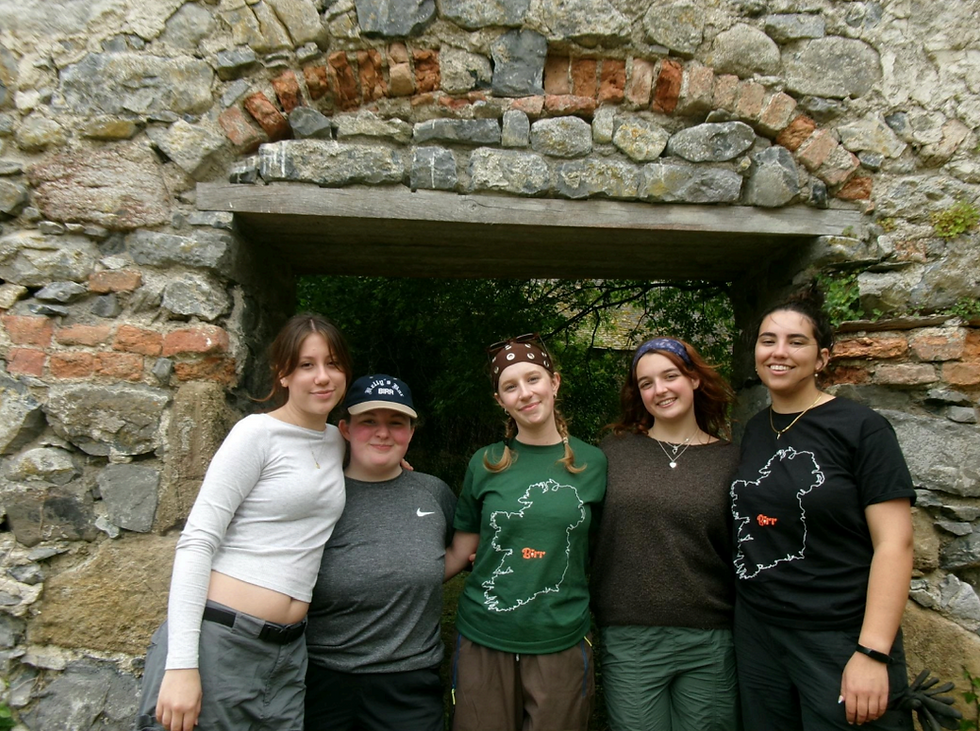
I promise this isn't a paid advertisement, but I'd highly recommend any of the IHS programs to history, archaeology and anthropology students, as well as anyone with a general interest in Irish medieval history, or anyone who feels they could do with a life-changing experience. Feel free to get in touch at alicia.king2@students.mq.edu.au if you have any questions :)
by Alicia King
References
[1] Lacy, R. S. (2024). Hexfoils in a Mortuary Context. In Daisy Wheel, Hexfoil, Hexafoil, Rosette: Protective Marks in Gravestone Art (1st ed., pp. 55–96). Berghahn Books. http://www.jstor.org/stable/jj.17634948.7


Comments