
Wildlife on Campus
Godzilla rats, bin chickens, eels and a couple of nice ones (I promise): Deputy Editor Kayleigh Greig takes you on a tour of Macquarie’s year-round tenants.
Every day, Wally’s Walk is trodden by everything from boots to sandals, but human feet aren’t the only ones to cross our corridors. Some are furred, some feathered, some scaled or footless entirely. With the diversity of outfits, hairstyles and faces to hold our attention, it’s easy to forget that Macquarie’s campus is not just home to a diverse array of staff and students, but animals as well. In fact, a recent post on the @maquarieuni Instagram boasts that the 2025 Guardians of Earth Rankings put MQ’s campus as the 6th most biodiverse in the world,[1,2] and it’s easy to see why when you contrast it with the concrete jungle campuses you can find in the city.
Of course, our most obvious place to connect with nature is the lake. When a friend first walked me along the creek line, he asked, “Can you see them?” Confused, I kept asking “Where?!” while he kept saying “There!” I felt like I was going crazy until suddenly, my eyes adjusted, and I saw one at last – a glistening green body bejewelled with golden eyes and webbed feet. It was like finally focusing a microscope. Now, I could see them everywhere — scattered like gems amongst the fronds.
They were Eastern Dwarf Tree Frogs (Litoria fallax), their high-pitched calls sounding like a loud “screeeech-pip-pip.” Interestingly, users of the FrogID app have found that these little guys are thriving, even moving outside of their natural range,[3] in contrast to their cousins, the Green and Golden Bell Frog (Litoria aurea) whose range shrinks[4] as a result of a highly infectious and fatal disease caused by the amphibian chytrid fungus.[5]

Indeed, the Australian Museum describes the Eastern Dwarf Tree Frog as a “tiny hitchhiker,” attributing its success to its ability to sneak onto transport to find new territory, in some cases 400km away from where it should be.[3] To keep track of frog movements, you can help as a “citizen scientist” by uploading your observations to research databases, either in photograph form or simply recordings of their calls. This is a duty sacred to the members of the Biology, Ecology and Environment Society (BEES), who regularly conduct “bioblitzes” in which they use apps such as FrogID, PlantNet and iNaturalist to snap pictures of and identify the current biodiversity on campus.
It's this dedicated group of eco-minded students that first introduced me to Kevin, a creature so beloved that he has an entire highlight reel dedicated to him on their Insta, @mq_bees. Who is Kevin, you ask? Kevin is an icon, a myth, a legend! He is the one true local celebrity at our university. Kevin is… a duck. But not just any duck – Kevin is large, white, suffers from a gammy leg, and is thus adored for his identifiable idiosyncrasy. Take a wander down to the lake any day and you’ll be sure to see him sticking out like a sore thumb amidst his gang of Australasian Black Ducks, Dusky Moorhens, Black Swans and White-faced Herons, to name a few.


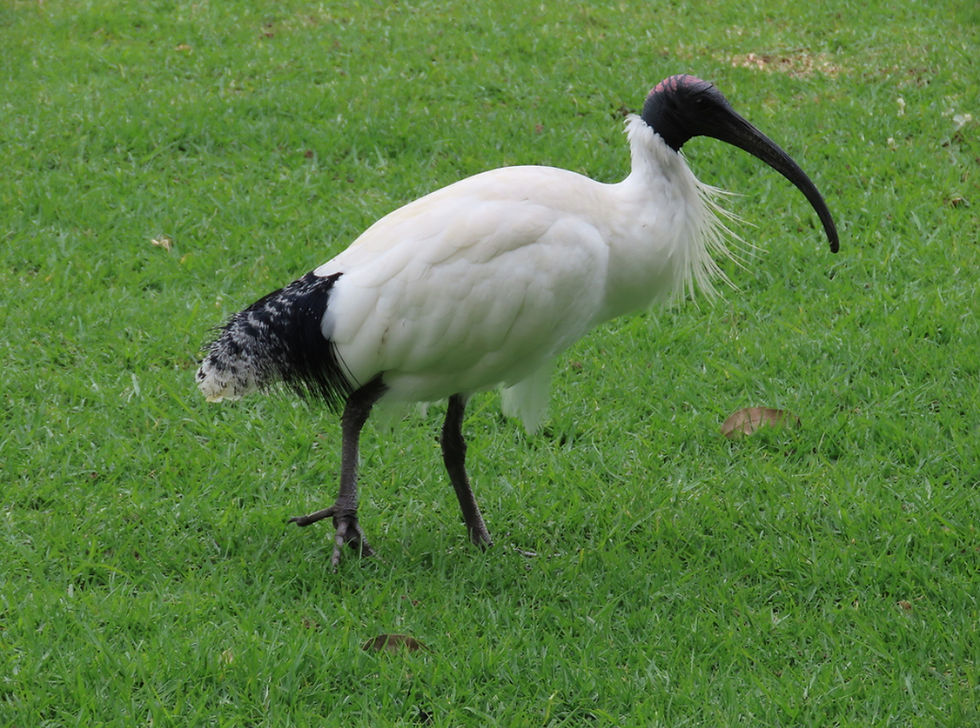
If you’re interested in birds, there are plenty more to find. Fluttering between the eucalypts, you’ll notice pink and grey Galahs (Eolophus roseicapilla), the slightly nerve-inducing Australian Magpie (Gymnorhina tibicen), and the classic Bin Chicken, formerly known as the Sacred Ibis (Threskiocornis molucca). If this creature stirs a feeling of disgust, maybe you’ll be swayed by the fact that ibises are monogamous; mating for life. The male bows to the female, offering her a twig as a touching offering reminiscent of an engagement ring. After that, the couple build and share a nest for the rest of their 28-year lifespans[6] Sweet, isn’t it? Though I must admit, their smell? Not so much… Ibises have a very distinct scent that I pray you’ll never come close enough to experience.

Regarding the other creatures you’ll find flying over the surface of the lake, don’t even get me started on the diversity of bug life. But actually… Please don’t. I must profess that I’m yet to develop my insect knowledge, but my Invertebrate Biology unit is next sem, okay? The most I can tell you is that dragonflies are abundant, and from a quick look at iNat, the list of scientific binomials is mind boggling.
Underneath the surface, however, you’ll find the lake’s depths are populated by freshwater eels, including the Short-finned Eel (Anguilla australis) and Australian Long-finned Eel (Anguilla reinhardtii). In fact, in 2019, efforts to restore Mars Creek specifically took eels into account, ensuring they had pathways to migrate from their existing habitat to further upstream.[7]


Of course, the lake isn’t the only wildlife home around. In my days completing a French minor, my classes spent at 25 Wally’s Walk were spiced up by the antics of the creatures scurrying between the bin and garden bed: rats. I never expected rodents to bring me such joy, but when my head was spinning with the complexity of foreign language verb conjugation, it was always a delight to catch a moment of respite by pointing out the little troublemakers to my classmates, eliciting a chorus of squeals. Only, our squeals quickly turned to screams when we glimpsed amongst the regular, demure little rats something that should not have been witnessed by human eyes. Was it a ferret? A cat? No. It was some kind of mutant abomination the likes of which I have never seen. I don’t know if it was from nibbling on Grapeshot magazines that gave this thing superpowers or what, but there was something incredibly, unsettlingly wrong about this beast of a rat, if I can even call it that. Take your lunch in the outside courtyard of the Arts building and see if you can spot it… if you dare.
Or you know, if you’re not keen to feel the contents of your stomach return to your throat, you could opt for a more pleasant wildlife-viewing experience at Macquarie’s fauna park, where the Department of Natural Science conducts a variety of research into “lizards, birds, frogs, fishes, spiders, bees, ants, Q-flies and a range of other invertebrates.”[8] The fauna park even used to be home to wallabies, as it began with research into macropods. If you can’t visit in person, at least hop onto the Fauna Park Fun Facts website to find out why researchers threw sickening sausages out of a helicopter, amongst other amusing and important initiatives.[9] Oh, to be an ecologist.
In all, dear reader, yes, you can find friends in your classes and societies, but don’t forget to check in the bushes and branches as well.
References:
[1] Macquarie University, @macquarieuni, “Macquarie has ranked 6th globally for its commitment to biodiversity health and efforts in sustainability!” Instagram, 3 April, 2025, https://www.instagram.com/p/DH-mqASOCOe/?igsh=MWh2ZTVpdWNyb2o2dA%3D%3D&img_index=1 (Accessed 3 April 2025).
[2] Guardians of Earth, “Nature Realms: Universities: All Time Bio Score,” 2025, https://www.guardiansofearth.io/.
[3] Rowley, Jodi. “Our tiny green hitchhiker: Citizen science reveals the frog popping up across eastern Australia.” Australian Museum, 30 June 2023, https://australian.museum/blog/amri-news/our-tiny-green-hitchhiker/ (Accessed 8 April 2025).
[4] FrogID. “Litoria Aurea.” Australian Museum, 2025, https://www.frogid.net.au/frogs/litoria-aurea, (Accessed 8 April 2025).
[5] DCCEEW. “Chytridiomycosis (Amphibian Chytrid Fungus Disease).” Australian Government, 2025, https://www.dcceew.gov.au/sites/default/files/documents/c-disease_1.pdf (Accessed 8 April 2025).
[6] Particle. “Particle 101: Australia’s Beloved Bin Chicken.” 2 December 2021, https://particle.scitech.org.au/earth/bin-chicken-more-than-trash-talk/ (Accessed 8 April 2025).
[7] Macquarie University. “Central Courtyard site area extension for Mars Creek upgrade.” This Week, 23 July 2019, https://www.mq.edu.au/thisweek/2019/07/23/central-courtyard-site-area-extension-for-mars-creek-upgrade/.
[8] Macquarie University. “Fauna Park: About.” 2025, https://www.mq.edu.au/research/research-centres-groups-and-facilities/secure-planet/facilities/fauna-park (Accessed 8 April 2025).
[9] Macquarie University. “Cane toad news (2016).” Fauna Park Fun Facts, 2016, https://mqoutlook.sharepoint.com/sites/FaunaParkFunFacts/SitePages/cane-toads.aspx#how-do-you-train-predators-not-to-eat-toxic-cane-toads (Accessed 8 April 2025).


Comments